
Metal circular saw blades HSS DMo5 and HSS-E (EMo5Co5)
Metal circular saw blades in HSS DMo5 (M2) and cobalt-alloyed HSS EMo5Co5 (HSS-E, M35) for cold saws and automatic circular sawing machines: Ø 200–450 mm, bore 32, 40 or 50 mm, number of teeth selectable to suit the diameter, steam-treated or with TiN, TiCN or TiAlN coating. Pin holes for all machine brands, regrindable. Order by noon for same-day dispatch. Buying guide & FAQ
Subcategories
Products (selection)
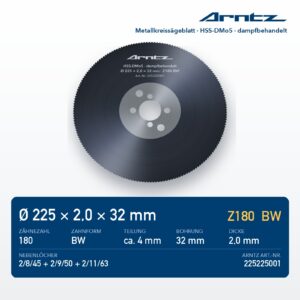
ARNTZ Metallkreissägeblatt HSS-DMo5 225x2,0x32 Z180 BW dampfbehandelt (225225001)
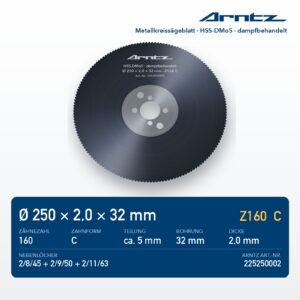
ARNTZ Metallkreissägeblatt HSS-DMo5 250x2,0x32 Z160 C dampfbehandelt (225250002)
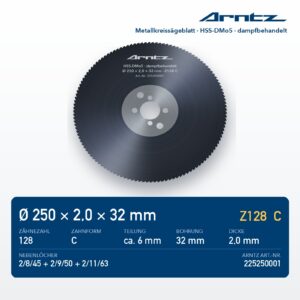
ARNTZ Metallkreissägeblatt HSS-DMo5 250x2,0x32 Z128 C dampfbehandelt (225250001)
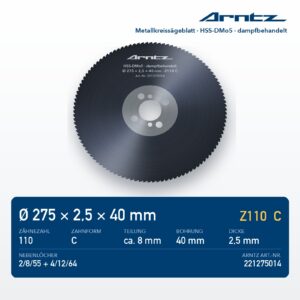
ARNTZ Metallkreissägeblatt HSS-DMo5 275x2,5x40 Z110 C dampfbehandelt (221275014)
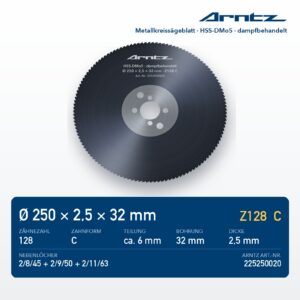
ARNTZ Metallkreissägeblatt HSS-DMo5 250x2,5x32 Z128 C dampfbehandelt (225250020)
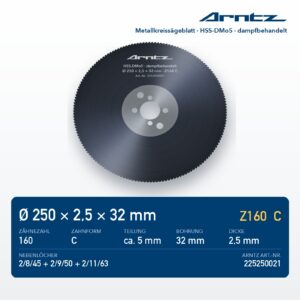
ARNTZ Metallkreissägeblatt HSS-DMo5 250x2,5x32 Z160 C dampfbehandelt (225250021)
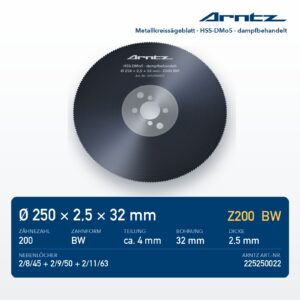
ARNTZ Metallkreissägeblatt HSS-DMo5 250x2,5x32 Z200 BW dampfbehandelt (225250022)
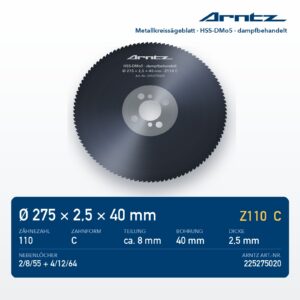
ARNTZ Metallkreissägeblatt HSS-DMo5 275x2,5x40 Z110 C dampfbehandelt (225275020)
View all 496 products in the shop
Product pages, basket and checkout are in German. Questions? Phone +49 9346 92230 or WhatsApp +49 171 4189690 – we also answer in English.
Choosing the right metal circular saw blade: material, size and number of teeth
A metal circular saw blade – also called an HSS circular saw blade or cold saw blade – is a saw blade made of high-speed steel (HSS) for slow-running metal circular saws. It cuts solid material, tubes and profiles of steel, stainless steel and non-ferrous metals with coolant at cutting speeds of usually 10 to 50 m/min. The cut surface is clean and has little burr, and the blade can be reground several times.
To choose, you need five details: blade material (HSS DMo5 or HSS EMo5Co5), surface, size (diameter × thickness × bore), number of teeth and the pin holes of your machine. In our configurators you freely choose the size, number of teeth and tooth form; after the diameter, only matching numbers of teeth appear, with the pitch shown.
HSS DMo5 or HSS EMo5Co5?
| Material | Application | Versions |
|---|---|---|
| HSS DMo5 M2 · 1.3343 | Structural and standard steels up to approx. 800 N/mm², tubes, profiles and solid material; also aluminium and non-ferrous metals | steam-treated · TiN · TiCN · TiAlN |
| HSS EMo5Co5 HSS-E · M35 · 1.3243 | with approx. 5 % cobalt: stainless steel (V2A, V4A), tough and higher-strength steels, series cutting | steam-treated · TiN · TiCN · TiAlN |
Surface: steam-treated, TiN, TiCN or TiAlN
- Steam-treated – iron oxide layer (Fe₃O₄), holds coolant on the tooth, fewer chips welding to the teeth; the economical standard for steel.
- TiN (titanium nitride, gold-coloured) – hard layer for longer tool life.
- TiCN (titanium carbonitride) – even harder, for profiles, tubes, interrupted cuts and higher cutting speeds.
- TiAlN (titanium aluminium nitride) – temperature-resistant when the cutting edge gets hot, e.g. in stainless steel and high-strength steels. Not for aluminium.
For aluminium and non-ferrous metals we supply bright, uncoated blades in all sizes on request.
Sizes and numbers of teeth
The tooth pitch is the distance from tooth to tooth: T = π × D ÷ Z. Thin-walled tubes and profiles need a fine pitch (about T3–T5), solid material a coarse one (about T8–T14) – at least two to three teeth should always be engaged. You will find detailed tables by material and cross-section in the guide Cutting speed and rotational speed.
| Diameter | Thickness × bore (mm) | Number of teeth selectable | Example |
|---|---|---|---|
| Ø 200 mm | 1.8 × 32, 2.0 × 32 | Z60–Z200 (T 3.1–10.5 mm) | Z60–Z200 |
| Ø 210 mm | 2.0 × 32 | Z60–Z200 (T 3.3–11.0 mm) | Z60–Z200 |
| Ø 225 mm | 2.0 × 32, 2.0 × 40 | Z60–Z220 (T 3.2–11.8 mm) | Z60–Z220 |
| Ø 250 mm | 2.0 × 32, 2.0 × 40, 2.5 × 32, 2.5 × 40 | Z60–Z260 (T 3.0–13.1 mm) | Z60–Z260 |
| Ø 275 mm | 2.0 × 32, 2.0 × 40, 2.5 × 32, 2.5 × 40 | Z60–Z280 (T 3.1–14.4 mm) | e.g. Z220 = T 3.9 mm |
| Ø 300 mm | 2.5 × 32, 2.5 × 40 | Z80–Z300 (T 3.1–11.8 mm) | Z80–Z300 |
| Ø 315 mm | 2.5 × 32, 2.5 × 40, 3.0 × 32, 3.0 × 40 | Z80–Z320 (T 3.1–12.4 mm) | e.g. Z160 = T 6.2 mm |
| Ø 325 mm | 3.0 × 40 | Z80–Z340 (T 3.0–12.8 mm) | Z80–Z340 |
| Ø 350 mm | 2.5 × 32, 2.5 × 40, 2.5 × 50, 3.0 × 32, 3.0 × 40, 3.0 × 50 | Z80–Z340 (T 3.2–13.7 mm) | e.g. Z180 = T 6.1 mm |
| Ø 370 mm | 3.0 × 32, 3.0 × 40, 3.0 × 50 | Z80–Z340 (T 3.4–14.5 mm) | Z80–Z340 |
| Ø 400 mm | 3.0 × 40, 3.0 × 50, 3.5 × 40, 3.5 × 50, 4.0 × 40, 4.0 × 50 | Z90–Z340 (T 3.7–14.0 mm) | e.g. Z200 = T 6.3 mm |
| Ø 425 mm | 3.5 × 40, 3.5 × 50, 4.0 × 40, 4.0 × 50 | Z90–Z340 (T 3.9–14.8 mm) | Z90–Z340 |
| Ø 450 mm | 3.0 × 40, 3.5 × 40, 3.5 × 50, 4.0 × 40, 4.0 × 50 | Z100–Z340 (T 4.2–14.1 mm) | e.g. Z180 = T 7.9 mm |
Fixed stock sizes with number of teeth (e.g. 350x3,0x40 Z180) are also in the list above; there too you can change the size and number of teeth. In addition, there are segmental circular saw blades in HSS in Ø 360, 400 and 450 mm.
Tooth form A, B, BW or C (HZ)
Tooth form A (DIN 1837, fine-toothed) for thin-walled material and flat cuts, B and BW (DIN 1838, curved tooth or with alternate bevel) for solid material and profiles, C with roughing and finishing teeth (HZ) for large cross-sections and thick-walled tubes. You choose the tooth form in the configurator at no extra charge (BW is preselected). More on this: Tooth forms A, B, BW and C explained.
Pin holes
We make the pin holes to suit all machine brands. Typical hole patterns: bore 32 mm – 2/8/45 + 2/11/63; bore 40 mm – 2/12/64 + 2/15/80; bore 50 mm – 4/15/80. How to read and measure your hole pattern: Determining pin holes.
Speed and cutting speed
n = vc × 1000 ÷ (π × D). Guide values for solid material: steel up to 500 N/mm² 30–50 m/min, up to 800 N/mm² 20–40 m/min, up to 1,200 N/mm² 15–25 m/min, stainless steel 10–30 m/min. Example: Ø 350 mm at 30 m/min ≈ 27 rpm. Speed table for all diameters: Speed guide; each product also has a PDF data sheet.
To fit your metal circular saw
Our blades fit cold saws, chop saws and semi- or fully automatic circular sawing machines, e.g. from Eisele, Behringer, Kaltenbach, Pedrazzoli, MEP, Thomas, Imet or FEMI – provided the diameter, thickness, bore and pin holes match the machine. We make special sizes, special tooth forms and blades to sample on request: Metal circular saw blades made to measure.
Regrinding and sharpening service
All HSS metal circular saw blades can be reground. As Werkzeugservice Hoeß in Grünsfeld, we regrind HSS and TCT circular saw blades – including blades from other manufacturers: Sharpening service for circular saw blades · all services.
Ordering and delivery
Order by noon for same-day dispatch. Within Germany with DHL from 7.20 € plus VAT, free shipping within Germany from 250 € order value (net). Questions about size, tooth form or pin holes: +49 9346 92230 or info@wsh-tools.de.
Custom-made blades and overview
Your size is not listed? Enter the diameter, thickness, bore, pin holes and number of teeth in the circular saw blade configurator – we make metal circular saw blades in HSS and HSS-E from 1 piece. You will find all circular saw blades from WSH-Tools.de compared – metal, carbide, segmental, CV and saw blades for branch saws – in the circular saw blade overview.
Frequently asked questions about metal circular saw blades
What is the difference between HSS DMo5 and HSS EMo5Co5?
HSS DMo5 (M2, material 1.3343) is the standard high-speed steel for structural and standard steels, tubes and profiles. HSS EMo5Co5 (M35, 1.3243, often called HSS-E or HSS-Co5) additionally contains around 5 % cobalt: the tooth stays hard longer under heat and wears more slowly. This makes EMo5Co5 the better choice for stainless steel, tough and higher-strength steels and for series cutting.
Which metal circular saw blade should I use for stainless steel (V2A, V4A)?
For regular cuts in stainless steel we recommend HSS EMo5Co5, steam-treated or with TiCN or TiAlN coating. Stainless steel needs a low cutting speed (about 10–30 m/min for solid material), plenty of coolant and a rather fine tooth pitch so that several teeth are always engaged.
How many teeth does my metal circular saw blade need?
The deciding factor is the tooth pitch T = π × diameter ÷ number of teeth. A Ø 350 mm blade with 180 teeth has T ≈ 6.1 mm. Thin-walled tubes and profiles need a fine pitch (about T3–T5), solid material a coarse one (about T8–T14), so that the chips fit into the gullet. In the shop, the selection by diameter only shows numbers of teeth with a pitch of 3 to 15 mm – with the pitch shown right next to them.
What do the dimensions 350x3,0x40 mean?
Diameter × blade thickness × bore in millimetres: 350 mm diameter, 3.0 mm blade thickness, 40 mm bore. Diameter and bore must match your machine; the machine manufacturer specifies the blade thickness for the diameter. In addition, the blade needs the pin holes of your clamping flange.
What are pin holes and how do I specify them?
Pin holes (drive holes) transmit the torque from the flange to the saw blade. They are specified as number/diameter/pitch circle, e.g. 2/11/63 = two holes of Ø 11 mm on a pitch circle of 63 mm. We make the pin holes to suit all machine brands – state your machine or the hole pattern when ordering.
What speed do I need for my metal circular saw blade?
Speed n = cutting speed vc × 1000 ÷ (π × diameter). For solid steel up to 800 N/mm², about 20–40 m/min applies; at Ø 350 mm and 30 m/min that is around 27 rpm. HSS metal circular saw blades therefore run very slowly; the machine manufacturer’s specifications and the maximum permitted speed always take priority.
Steam-treated, TiN, TiCN or TiAlN – which surface is right?
Steam-treated is the economical standard: the iron oxide layer holds coolant on the tooth and reduces chips welding to the teeth. TiN, TiCN and TiAlN are hard coatings for longer tool life; TiCN is particularly suitable for profiles, tubes and interrupted cuts, TiAlN for high temperatures at the cutting edge, e.g. in stainless steel. For aluminium and non-ferrous metals, bright uncoated blades are available on request.
Which tooth form do I need: A, B, BW or C?
Tooth form A (DIN 1837, fine) for thin-walled tubes, profiles and flat cuts; B (DIN 1838, curved tooth) for solid material and tough, soft materials; BW (curved tooth with alternate bevel) as the versatile standard for solid material and profiles; C with roughing and finishing teeth (HZ) for large cross-sections and thick-walled tubes. You choose the tooth form in the configurator at no extra charge; BW is preselected.
Do the saw blades fit my metal circular saw?
Yes, if the diameter, blade thickness, bore and pin holes match your machine – for example for cold saws and automatic circular sawing machines from Eisele, Behringer, Kaltenbach, Pedrazzoli, MEP, Thomas, Imet or FEMI. We make the pin holes to your specification. If in doubt, call us: +49 9346 92230.
Can I have metal circular saw blades reground?
Yes. All our HSS metal circular saw blades can be reground. As Werkzeugservice Hoeß, we regrind HSS and TCT circular saw blades in Grünsfeld – including blades from other manufacturers.
How fast are metal circular saw blades delivered?
Order by noon for same-day dispatch. Within Germany we ship with DHL from 7.20 € plus VAT, free shipping within Germany from 250 € order value (net). Please enquire in advance about special sizes, tooth forms and pin holes to sample.