
Indexable inserts to ISO – carbide, cermet, PCD and CBN
Turning inserts from stock: negative inserts such as CNMG, DNMG and WNMG, positive ones such as CCMT, DCMT and VCMT – for steel, stainless steel, cast iron, aluminium and superalloys. The finder leads you to the right insert in three steps. Order by noon for same-day dispatch.
Subcategories
Products (selection)
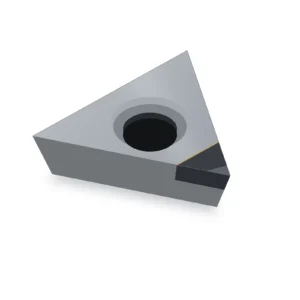
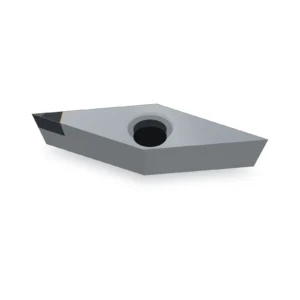


Wendeschneidplatte RCMX 0803


Wendeschneidplatte CCGT 09T3023 poliert für Aluminium
View all 119 products in the shop
Product pages, basket and checkout are in German. Questions? Phone +49 9346 92230 or WhatsApp +49 171 4189690 – we also answer in English.
The ISO designation of indexable inserts explained
Every indexable insert has a designation to ISO 1832, for example CNMG 120408-OPR. The four letters describe the shape and version, the three pairs of digits the size, thickness and corner radius, and the code after the hyphen the chipbreaker. For the insert seat in the holder, the shape, clearance angle, fixing, size and thickness count.
| Position | Example | Meaning |
|---|---|---|
| 1 Basic shape | C | Rhombic 80° (C, D, S, T, V, W, R, K) |
| 2 Clearance angle | N | 0° = negative, double-sided; B 5°, C 7°, P 11° = positive |
| 3 Tolerance | M | Standard tolerance (sintered); G/E = ground |
| 4 Fixing | G | Hole, chipbreaker on both sides (A, M, G, T, W …) |
| 5 Size | 12 | Cutting edge length 12.9 mm, inscribed circle 12.7 mm |
| 6 Thickness | 04 | 4.76 mm |
| 7 Corner radius | 08 | 0.8 mm |
| 8 Chipbreaker | OPR | Manufacturer’s code: steel (P), roughing (R) |
Basic shape: which insert for which operation?
The larger the corner angle, the more stable the cutting corner; the more pointed, the better the insert gets into contours.
| Shape | Corner angle | Typical application | In the shop, e.g. |
|---|---|---|---|
| C Rhombic | 80° | Longitudinal turning and facing, all-rounder | CNMG 120408, CCMT 09T304 |
| D Rhombic | 55° | Copy and profile turning | DNMG 150608, DCMT 11T304 |
| S Square | 90° | Roughing, chamfering, very stable corner | SNMG 120408, SCMT 09T304 |
| T Triangular | 60° | Longitudinal turning, internal turning | TNMG 160408, TCMT 16T308 |
| V Rhombic | 35° | Fine copying, tight contours | VNMG 160408, VCMT 110302 |
| W Trigon | 80° | Longitudinal turning and facing, three corners per side | WNMG 080408 |
| R Round | – | Copying and roughing, very stable cutting edge | RCMX 0803 |
| K Parallelogram | 55° | Facing and copy turning | KNUX 160405 |
Negative or positive insert?
Negative inserts (second letter N, clearance angle 0°) such as CNMG, DNMG, SNMG, TNMG, VNMG and WNMG can be used on both sides and therefore have twice as many cutting corners. They are very stable and economical – from roughing to finishing. They sit inclined in clamp holders with lever, toggle or wedge clamping (e.g. MCLNR, PCLNR, DCLNR).
Positive inserts (B = 5°, C = 7°, P = 11°) such as CCMT, DCMT, VCMT, VBMT and TCMT are single-sided, cut more easily and generate less cutting force. They are suitable for small machines, slender parts, aluminium and internal turning with boring bars and are fixed with a countersunk screw (holders e.g. SCLCR, SDJCR, SVJBR).
Size, thickness and corner radius
The size (positions 5–6) is the rounded cutting edge length. Inserts of the same size in different shapes have the same inscribed circle:
| Inscribed circle | C | D | S | T | V | W |
|---|---|---|---|---|---|---|
| 6.35 mm | 06 | 07 | 06 | 11 | 11 | – |
| 9.525 mm | 09 | 11 | 09 | 16 | 16 | 06 |
| 12.7 mm | 12 | 15 | 12 | 22 | 22 | 08 |
| 15.875 mm | 16 | – | 15 | 27 | – | – |
| 19.05 mm | 19 | – | 19 | 33 | – | – |
| 25.4 mm | 25 | – | 25 | – | – | – |
Thickness (positions 7–8): 02 = 2.38 mm, 03 = 3.18 mm, T3 = 3.97 mm, 04 = 4.76 mm, 06 = 6.35 mm, 07 = 7.94 mm, 09 = 9.52 mm.
Corner radius (positions 9–10) in tenths of a millimetre: 04 = 0.4 mm, 08 = 0.8 mm, 12 = 1.2 mm. Small radii cut more finely and with less vibration; large radii make the corner more stable and allow higher feeds. Rule of thumb: feed in mm/rev at most about half the corner radius.
Material groups P, M, K, N, S and H to ISO 513
The machining group of the workpiece determines the grade and chipbreaker. The colours are the same in all catalogues.
| Group | Colour | Materials | Matching in the shop |
|---|---|---|---|
| P | blue | Steel and cast steel, unalloyed and alloyed | CNMG …-OPF / -OPM / -OPR, cermet |
| M | yellow | Stainless steel (e.g. 1.4301, 1.4571) | CNMG …-OMF / -OMM / -OMR, -MF, -MSF |
| K | red | Cast iron (grey and nodular cast iron) | CNMG …-OKM / -OKR, CNMA |
| N | green | Aluminium, copper, brass, non-ferrous metals, plastics | CCGT polished, PCD inserts |
| S | brown | Superalloys (e.g. Inconel) and titanium | CNMG -OSM, -SMM |
| H | grey | Hardened steels (approx. 45–65 HRC), chilled cast iron | CBN – suitable grade on request |
Chipbreaker: fine finishing, finishing or roughing
The chipbreaker forms and breaks the chip. Fine finishing means a small depth of cut and low feed for the best surface, finishing the universal medium operation, roughing a large depth of cut and high feed.
On our CNMG inserts, the chipbreaker is in the name: the second letter gives the material group, the third the operation – OPF, OPM and OPR for steel, OMF, OMM and OMR for stainless steel, OKM and OKR for cast iron, OSM for superalloys. MF and MSF are fine-finishing geometries for stainless steel, SMM for superalloys. For many other inserts, you choose the material and chipbreaker as a variant on the product page; the finder preselects them when opening.
Cutting materials: carbide, cermet, PCD and CBN
- Carbide, CVD- or PVD-coated: the standard for steel, stainless steel, cast iron and superalloys.
- Cermet: for finishing steel with a very good surface and high dimensional accuracy.
- PCD (polycrystalline diamond): for aluminium, non-ferrous metals and plastics – not for steel.
- CBN (cubic boron nitride): generally for hard turning hardened steels; the round RCGX in the shop is made for turning carbide (e.g. mill rolls).
Coated inserts are CVD- or PVD-coated. WSH-Tools.de offers all common PVD coatings for its tools.
Thread turning, parting off and special shapes
In addition to the ISO turning inserts, we stock thread turning inserts and parting-off inserts ZQMX. We make profile and special tools in carbide, PCD and CBN to drawing: Special tools.
Frequently asked questions about indexable inserts
What does the designation CNMG 120408 mean?
CNMG 120408 is an ISO designation to ISO 1832: C = basic shape rhombic 80°, N = clearance angle 0° (negative insert, usable on both sides), M = tolerance class, G = hole with chipbreaker on both sides, 12 = cutting edge length 12.9 mm (inscribed circle 12.7 mm), 04 = insert thickness 4.76 mm and 08 = corner radius 0.8 mm. A code after the hyphen, e.g. OPR, denotes the manufacturer’s chipbreaker.
What is the difference between CNMG and CCMT?
CNMG is a negative insert (clearance angle 0°): usable on both sides, very stable, for roughing to finishing in clamp holders. CCMT is positive (clearance angle 7°): single-sided, cuts more easily with less cutting force and is fixed with a countersunk screw – good for small machines, slender parts and internal turning. Both have the basic shape C (rhombic 80°) but do not fit the same holder.
Which insert is suitable for stainless steel?
For stainless steel (ISO group M, e.g. 1.4301 or 1.4571), choose an insert with a sharp, positive chipbreaker for stainless steel, for example CNMG …-OMM for finishing, …-MF or …-MSF for fine finishing and …-OMR for roughing. A steady feed, sufficient depth of cut to counter work hardening and coolant are important.
Which insert is suitable for aluminium?
For aluminium and non-ferrous metals (ISO group N), polished, sharp positive inserts such as CCGT, CCGX, DCGX, SCGX and TCGX in the “aluminium” version or PCD inserts (polycrystalline diamond) are suitable. They prevent built-up edges and produce smooth surfaces.
Which corner radius do I need?
0.2 to 0.4 mm for finishing, small depths of cut and slender parts, 0.8 mm as an all-rounder and 1.2 to 2.4 mm for roughing with high feeds. As a rule of thumb, the feed in mm/rev should be at most about half the corner radius.
Do inserts from WSH-Tools fit my holder?
Yes, if the ISO designation matches the insert seat: basic shape, clearance angle, size and thickness (e.g. CNMG 1204…) must match the holder – regardless of the manufacturer. Corner radius and chipbreaker code do not change the seat.
How do I quickly find the right insert?
The easiest way is the insert finder at the top of this page: choose the material, operation and insert shape, and the list immediately shows only matching inserts. The shape is in the designation of the old insert or the holder. If you have questions, we can help on +49 9346 92230.
How many inserts do I have to order and how fast will they arrive?
The price is per piece. The minimum order quantity is shown on each insert; it is usually 10 pieces, PCD and CBN inserts are available from 1 piece. All inserts are available from stock: order by noon for same-day dispatch.