
Carbide rotary burrs Ø 12 mm
Carbide rotary burrs Ø 12 mm with 6 mm shank – manufactured in Germany. The carbide head is silver-brazed in German industrial quality. With double cut, the burrs deburr edges, dress weld seams and work contours in steel, cast steel, stainless steel and cast iron; for aluminium and non-ferrous metals there is shape C with ALU cut. You can choose from shapes A cylinder, C ball-nosed cylinder, F ball-nosed tree, G pointed tree and L ball-nosed cone – individually, in packs of 5 or together in the 5-piece rotary burr set. Suitable for die grinders and pneumatic die grinders with a 6 mm collet.
Products (selection)
Hartmetall-Frässtift Form C Walzenrund (WRC) Ø 12 × 25 mm, Schaft 6 mm, ALU-Verzahnung
Hartmetall-Frässtift Form G Spitzbogen (SPG) Ø 12 × 25 mm, Schaft 6 mm, Kreuzverzahnung
Hartmetall-Frässtift Form F Rundbogen (RBF) Ø 12 × 25 mm, Schaft 6 mm, Kreuzverzahnung
Hartmetall-Frässtift Form L Rundkegel (KEL) Ø 12 × 28 mm, Schaft 6 mm, Kreuzverzahnung
Hartmetall-Frässtift Form C Walzenrund (WRC) Ø 12 × 25 mm, Schaft 6 mm, Kreuzverzahnung
Hartmetall-Frässtift Form A Zylinder (ZYA) Ø 12 × 25 mm, Schaft 6 mm, Kreuzverzahnung
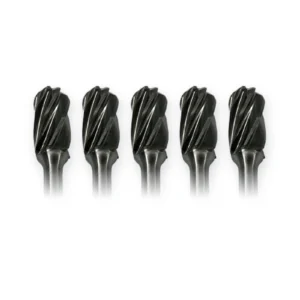
Hartmetall-Frässtift Form C Walzenrund (WRC) Ø 12 × 25 mm, Schaft 6 mm, ALU-Verzahnung – 5er-Pack
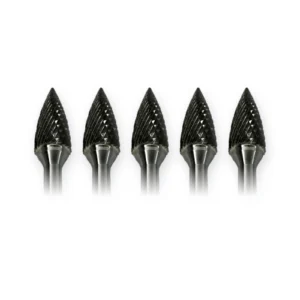
Hartmetall-Frässtift Form G Spitzbogen (SPG) Ø 12 × 25 mm, Schaft 6 mm, Kreuzverzahnung – 5er-Pack
View all 13 products in the shop
Product pages, basket and checkout are in German. Questions? Phone +49 9346 92230 or WhatsApp +49 171 4189690 – we also answer in English.
Rotary burr shapes at a glance
The head shape determines which contour the rotary burr produces. All carbide rotary burrs in this category have a 12 mm head diameter and a 6 mm shank. The code sums up shape and dimensions: ZYA 1225/6, for example, stands for cylinder, head Ø 12 mm, head length 25 mm, shank 6 mm.
| Shape | Code | Picture / identifying feature | Typical application | Order |
|---|---|---|---|---|
| Shape A – cylinder | ZYA 1225/6 | 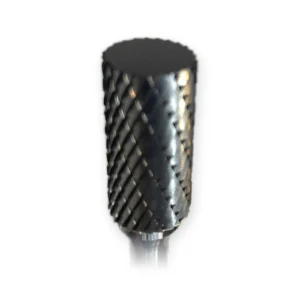 Cylinder, plain end without end cut | Flat surfaces, edges and shoulders; the plain end protects the base | Single · Pack of 5 |
| Shape C – ball-nosed cylinder | WRC 1225/6 | 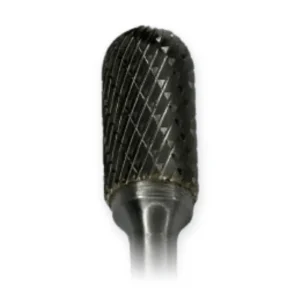 Cylinder with radius end | Surfaces and fillets with a radius, dressing weld seams, removing casting burrs | Single · Pack of 5 |
| Shape C – ball-nosed cylinder, ALU cut | WRC 1225/6 ALU | 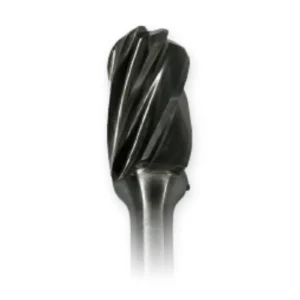 like shape C, coarse ALU cut | Aluminium, copper, brass, zinc and plastics – does not clog | Single · Pack of 5 |
| Shape F – ball-nosed tree | RBF 1225/6 | 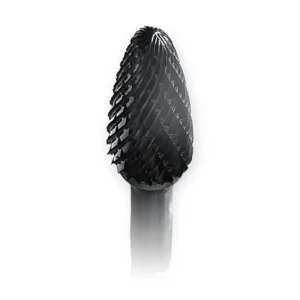 Tree shape with round end | Concave fillets, contours and fillet welds | Single · Pack of 5 |
| Shape G – pointed tree | SPG 1225/6 | 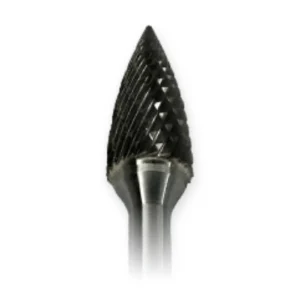 pointed tree shape | Tight spots and openings, deburring, contours | Single · Pack of 5 |
| Shape L – ball-nosed cone | KEL 1228/6 | 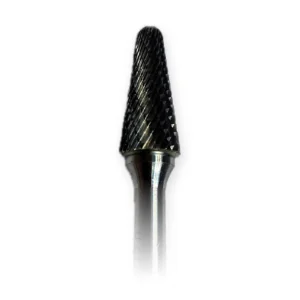 Cone with radius end, head length 28 mm | Chamfers, angles and conical contours, e.g. in mould making and deburring | Single · Pack of 5 |
All five shapes with double cut are available together in the rotary burr set, carbide Ø 12 mm, 5 pieces – 10 % cheaper than the five single burrs.
Double cut or ALU cut: the right rotary burr for the material
Double cut (also called “diamond cut”) is the universal cut for metal. The crossed cutting edges produce short chips and the burr is easy to guide. It is suitable for steel, cast steel, hardened and quenched and tempered steel, stainless steel (INOX) and cast iron. All shapes A, C, F, G and L have this cut.
ALU cut is coarse and clears chips well. It does not clog in soft materials and is intended for aluminium, copper, brass, zinc and plastics. A double-cut burr quickly clogs in aluminium – for this there is the shape C ball-nosed cylinder with ALU cut.
Rule of thumb: the harder or tougher the material, the lower the speed and the less contact pressure. Work stainless steel at low speed and with an even feed so that it does not overheat.
Speed for carbide rotary burrs Ø 12 mm
Carbide rotary burrs need high speeds. How high depends on the material and the head diameter. For our burrs with a 12 mm head, these guide values apply:
| Material | Cut | Speed (guide value) |
|---|---|---|
| Steel up to 1,200 N/mm², cast steel, grey cast iron | Double cut | 12,000–16,000 min⁻¹ |
| Hardened / quenched and tempered steel over 1,200 N/mm² | Double cut | 7,000–9,000 min⁻¹ |
| Stainless steel (INOX) | Double cut | 7,000–8,000 min⁻¹ |
| Aluminium, non-ferrous metals, plastic | ALU cut | 16,000–30,000 min⁻¹ |
- Start with the lower speed and increase according to the cutting pattern. Too low a speed leads to chatter and broken teeth.
- Many die grinders run at 20,000–30,000 min⁻¹ at idle. For steel and stainless steel, use a tool with speed control.
- Drills usually only reach around 3,000 min⁻¹. That is too slow for 12 mm carbide rotary burrs.
- Rule of thumb for other diameters: speed (min⁻¹) ≈ cutting speed (m/min) × 318 ÷ head diameter (mm).
Silver-brazed instead of copper-brazed
If the head is larger than the shank, as with a 12 mm head on a 6 mm shank, only the head is made of carbide. It is brazed onto a steel shank, and this joint has to absorb shocks and vibration in use. Our rotary burrs are silver-brazed in German industrial quality. Silver solder is processed at a much lower temperature than copper solder. The carbide head is heated less during brazing, and less stress develops in the carbide. With copper-brazed or friction-welded rotary burrs, on the other hand, the joint between head and shank is the typical weak point. More on brazing carbide: Brazed carbide tools.
Single, pack of 5 or set: shipping and quantities
- Single burr: each shape individually, in its own protective sleeve.
- Pack of 5: five burrs of the same shape, 5 % cheaper than five single burrs.
- Rotary burr set: one burr each of shapes A, C, F, G and L, 10 % cheaper than the five single burrs.
Shipping within Germany up to 5 pieces as a DHL small parcel for 4.15 € plus VAT (a pack of 5 counts as 5 pieces), above that as a DHL parcel for 7.20 € plus VAT. Free shipping within Germany from 250 € order value (net). For quantities of 100 pieces or more we will prepare a quote: Enquiry via the contact form.
Frequently asked questions about carbide rotary burrs
What do shapes A, C, F, G, L and the codes ZYA, WRC, RBF, SPG and KEL mean?
The letter denotes the head shape, the code gives the shape and dimensions: ZYA is the cylinder without end cut (shape A), WRC the ball-nosed cylinder (shape C), RBF the ball-nosed tree (shape F), SPG the pointed tree (shape G) and KEL the ball-nosed cone (shape L). “ZYA 1225/6”, for example, means head Ø 12 mm, head length 25 mm, shank 6 mm.
Which rotary burr is suitable for which application?
For flat surfaces, edges and shoulders shape A cylinder; for surfaces and fillets with a radius and for dressing weld seams shape C ball-nosed cylinder. Concave fillets and fillet welds are worked with shape F ball-nosed tree, tight spots and openings with the pointed shape G pointed tree, chamfers and conical contours with shape L ball-nosed cone. If you have various tasks, you are well equipped with the 5-piece rotary burr set.
What speed do I need for a rotary burr with 12 mm diameter?
Guide values for Ø 12 mm: steel up to 1,200 N/mm², cast steel and grey cast iron 12,000–16,000 min⁻¹, hardened or quenched and tempered steel over 1,200 N/mm² 7,000–9,000 min⁻¹, stainless steel 7,000–8,000 min⁻¹. With ALU cut in aluminium, non-ferrous metals and plastic 16,000–30,000 min⁻¹. Start with the lower speed and increase according to the cutting pattern.
Double cut or ALU cut – what do I need for steel, stainless steel and aluminium?
For steel, cast steel, stainless steel and cast iron the double cut (also called diamond cut). For aluminium, copper, brass, zinc and plastics the ALU cut: its coarse chip spaces do not clog in soft materials, whereas a double-cut burr does.
What does “silver-brazed in German industrial quality” mean?
On rotary burrs with a 12 mm head on a 6 mm shank, the carbide head is brazed onto a steel shank. Our rotary burrs are brazed with silver solder, which is processed at a lower temperature than copper solder. This protects the carbide during brazing and produces a strong joint between head and shank. The burrs are manufactured in Germany.
Can I use the rotary burrs in a die grinder, pneumatic die grinder or drill?
Die grinders and pneumatic die grinders with a 6 mm collet are the right choice, ideally with speed control and from approx. 300 W power. A drill usually only reaches around 3,000 min⁻¹, which is too slow for 12 mm carbide rotary burrs. Clamp the shank as deep as possible, work with light pressure and wear safety goggles.