
Gun drills · solid carbide and brazed · Ø 1 to 40 mm
Deep hole drilling with gun drills solid carbide and brazed, made to order
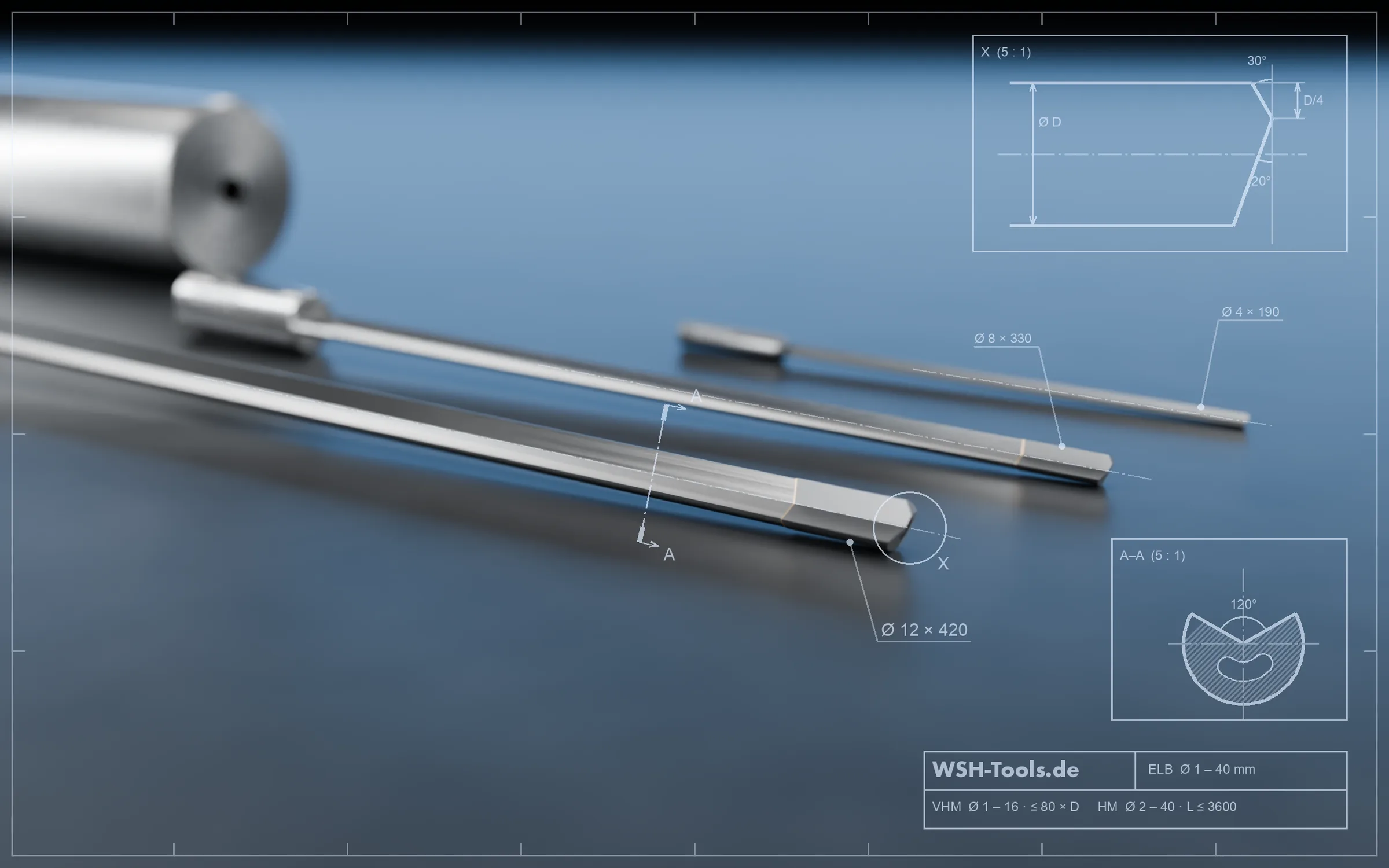
WSH-Tools.de supplies gun drills for deep hole drilling: solid carbide gun drills from Ø 1 to 16 mm and up to 80 × D, and gun drills with a brazed carbide head from Ø 2 to 40 mm and up to 3,600 mm overall length. They run on deep hole drilling machines and on machining centres, in metric and inch sizes, and are also available as step drills or with a full radius. We supply the tools; we do not offer contract deep hole drilling.
Get in touch – diameter, hole depth, material and machine are enough to get started.
- Ø 1 to 40 mm
- Up to 80 × D in a single pass (solid carbide)
- Up to 3,600 mm overall length (brazed)
- Metric and inch sizes
What is deep hole drilling?
In deep hole drilling, the hole is very deep in relation to its diameter. The VDI 3210 guideline sets the threshold as low as about three times the diameter. On the shop floor, people usually speak of deep hole drilling from 10 to 15 × D, because that is where twist drills reach their limits: chips pack up, the coolant no longer reliably reaches the cutting edge, and the hole starts to drift.
Deep hole drilling tools solve these problems. They deliver coolant to the cutting edge at high pressure, flush the chips out in a controlled way and support themselves against the bore wall on guide pads. The result is straight, accurate holes with a good surface finish, even at great depths, often in a single pass with no reaming.
Typical parts include camshafts, crankshafts and drive shafts, fuel injection nozzles and injectors, hydraulic manifolds, cooling channels in moulds and dies, medical instruments, drill pipe for oil and gas production, and dies for pellet and feed mills.
The three deep hole drilling methods
Gun drilling
For small and medium diameters up to about 40 mm. Coolant flows through the inside of the tool to the cutting edge, and the chips return along the outside through the V-shaped flute. Runs on deep hole drilling machines and on machining centres. This is the process we supply tools for.
BTA drilling
For larger diameters, usually from about 20 mm. Coolant is fed in from the outside, between the drill tube and the bore wall, and the chips are evacuated through the inside of the drill tube. This requires a deep hole drilling machine with a drilling oil supply.
Ejector drilling
Also for larger diameters. A double tube supplies the coolant and draws the chips out by suction. No seal is needed at the workpiece, so the process can also be used on conventional machines.
Gun drills from WSH-Tools.de
Solid carbide gun drills
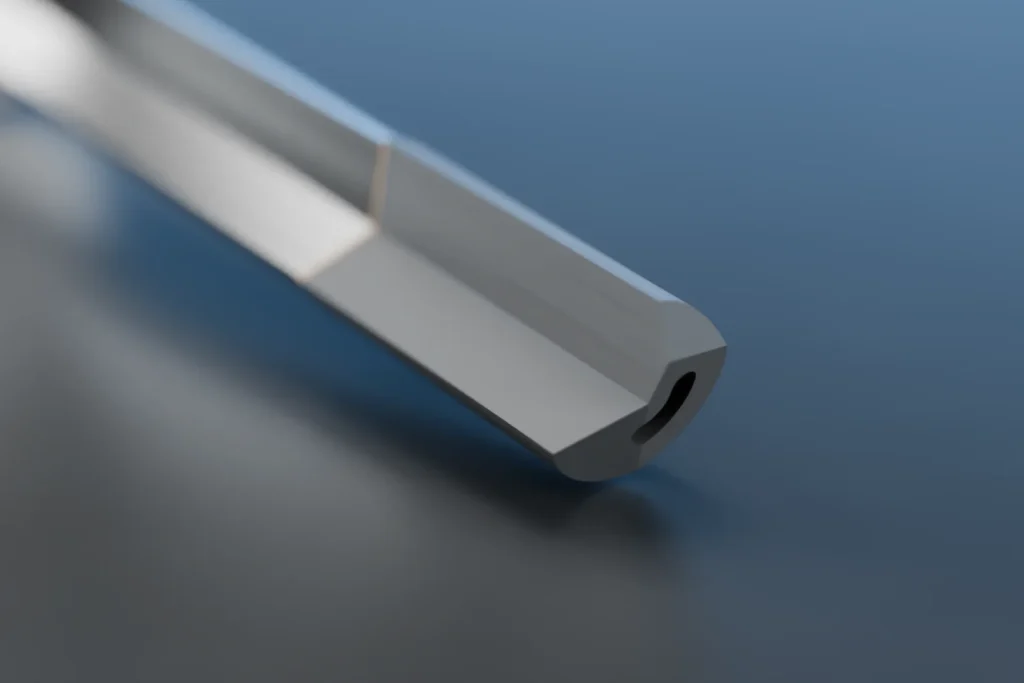
- Nominal diameter 1.000 to 16.000 mm
- Flute length up to 580 mm
- Up to 80 × D with a single tool
- Shank end for minimum quantity lubrication (MQL) available
- For tight hole tolerances
- For virtually all materials
- Wide range of inch sizes
Gun drills with a brazed carbide head
- Nominal diameter 2.000 to 40.000 mm
- Overall length up to 3,600 mm
- Many designs, for example with a full radius or as step drills
- Drivers for machining centres and deep hole drilling machines
- For virtually all materials
- Wide range of inch sizes
Which version is the most economical depends on the required hole quality, the machine, the batch size and the hole depth. We review your details and recommend the right tool.
How a gun drill works
A single cutting edge
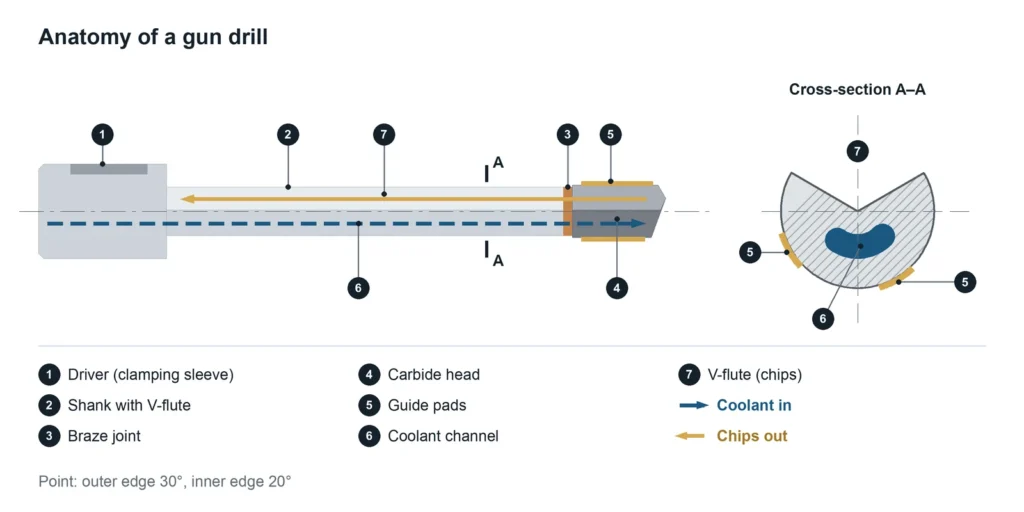
The carbide head has just one cutting edge, split into an outer and an inner edge. The point sits off-centre, so the cutting forces balance each other out.
Guide pads
The cutting forces push the head against the guide pads. They support the tool against the bore wall and burnish it as they go. This keeps the hole straight and round.
Coolant channel
A kidney-shaped channel in the shank carries high-pressure coolant right up to the cutting edge. The coolant cools, lubricates and pushes the chips out of the hole.
V-flute
The chips flow back with the coolant through the V-groove formed along the length of the shank. Short, broken chips are a must for reliable deep hole drilling.
Solid carbide or brazed: which gun drill is right for you?
Solid carbide gun drills
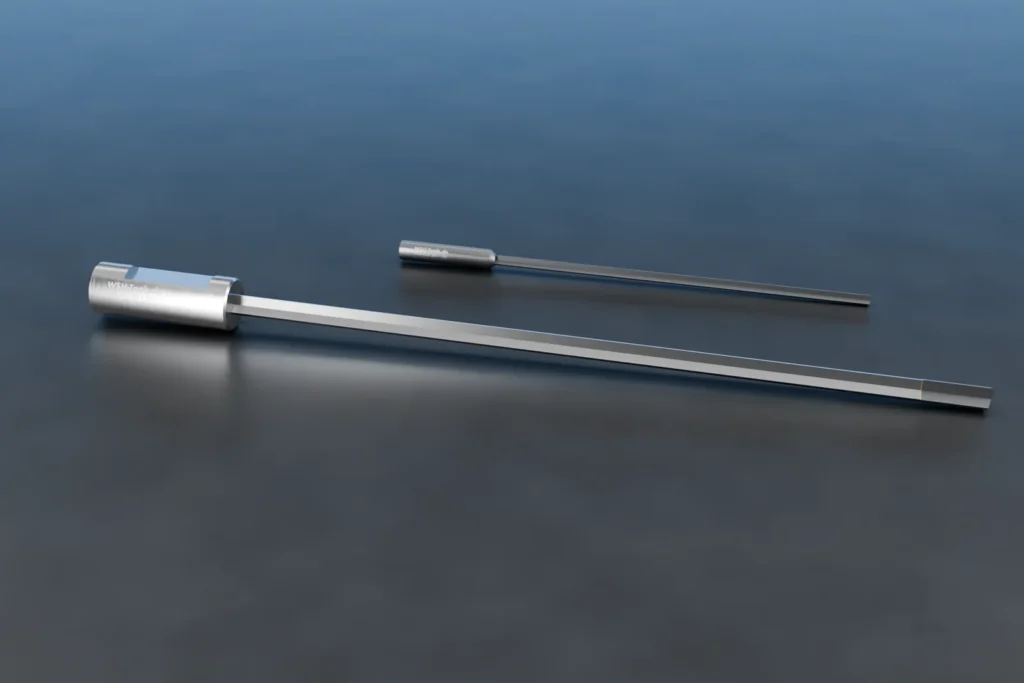
Made from a single piece of carbide and very rigid. That allows high feed rates and tight tolerances, especially in small diameters and on machining centres. You can drill up to 80 × D in a single pass.
Brazed gun drills
The carbide head sits on a steel shank. That makes large diameters and very long tools up to 3,600 mm possible. Special forms such as steps or a full radius at the bottom of the hole are straightforward to produce.
Machining centre or deep hole drilling machine
On a deep hole drilling machine
A guide bushing steadies the gun drill as it starts the hole. The workpiece often rotates in the opposite direction to the tool, which reduces drift. Drilling is usually done with deep hole drilling oil.
On a machining centre
Instead of a guide bushing, a short, accurate pilot hole guides the tool. The gun drill feeds in slowly and is only brought up to speed once it is inside the pilot hole. The internal coolant supply must deliver enough pressure.
The smaller the diameter, the higher the coolant pressure needs to be to flush the chips out reliably. Deep hole drilling oil lubricates better than emulsion, but drilling with emulsion is possible. For solid carbide gun drills, a shank end for minimum quantity lubrication is available.
Industries and applications
Automotive
Oil holes in camshafts and crankshafts, drive shafts, fuel injection nozzles and injectors.
Hydraulics and general engineering
Hydraulic manifolds, valve bodies, spindles and shafts.
Mould and die making
Long cooling and temperature control channels in moulds and dies.
Medical technology
Instruments and implants with tight tolerances.
Oil, gas and aerospace
Drill pipe and components with demanding reliability requirements.
Food and animal feed
Large numbers of deep holes in dies for pellet and feed mills.
Your quote in three steps
- Describe the hole. Diameter with tolerance, hole depth, workpiece material and quantity. A drawing or a sample helps.
- Tell us about your machine. Machining centre or deep hole drilling machine, holder or driver, coolant (deep hole drilling oil, emulsion or MQL) and the available pressure.
- Get your quote. We go through every enquiry by hand, recommend the right tool and give you a price and delivery time.
Frequently asked questions
At what depth does drilling count as deep hole drilling?
The VDI 3210 guideline sets the threshold as low as hole depths of about three times the diameter. In practice, deep hole drilling usually starts at 10 to 15 × D, because that is where twist drills reach their limits and deep hole drilling tools such as gun drills work more economically and more accurately.
What is a gun drill?
A gun drill is a deep hole drilling tool with a single cutting edge. It has a carbide head with guide pads, a V-flute formed along its length to carry the chips away, and an internal coolant channel that delivers coolant to the cutting edge at high pressure. It takes its name from the job it was originally used for: drilling gun barrels.
Which gun drills does WSH-Tools.de supply?
Solid carbide gun drills from Ø 1.000 to 16.000 mm with flute lengths up to 580 mm and up to 80 × D, and gun drills with a brazed carbide head from Ø 2.000 to 40.000 mm and up to 3,600 mm overall length – in metric and inch sizes, also as step drills or with a full radius.
Solid carbide or brazed – which gun drill is right for me?
Solid carbide gun drills are very rigid and allow high feed rates and tight tolerances, especially in small diameters and on machining centres. Brazed gun drills offer large diameters, very long tools up to 3,600 mm and special forms such as steps or a full radius. Based on the hole, the machine and the batch size, we recommend the most economical option.
Can I use gun drills on a machining centre?
Yes. On a machining centre, a short, accurate pilot hole guides the tool instead of a guide bushing. The drill feeds slowly into the pilot hole, is only brought up to speed once inside it, and needs an internal coolant supply with sufficient pressure. We also supply matching drivers.
Do I need a pilot hole?
On a machining centre, yes: it takes the place of the guide bushing on a deep hole drilling machine and guides the gun drill as it starts the hole. The pilot hole must be accurate and only slightly larger than the drill. On a deep hole drilling machine, the guide bushing does this job.
Which coolant do I need for deep hole drilling?
Deep hole drilling oil lubricates best and is the first choice; drilling with emulsion is possible. Sufficient pressure is essential: the smaller the diameter, the higher it must be to flush the chips out reliably. For solid carbide gun drills, a shank end for minimum quantity lubrication (MQL) is available.
Why are deep holes so straight and smooth?
The guide pads of the gun drill bear against the freshly drilled wall and burnish it. This produces straight, round holes with a good surface finish, even at great depths, often without reaming. How accurate a hole turns out depends on the machine, the material, the guidance and the coolant supply.
What is the difference between gun drilling, BTA drilling and ejector drilling?
In gun drilling, the coolant flows through the inside of the tool and the chips return along the outside through the flute; the process covers small and medium diameters up to about 40 mm. BTA drilling works the other way round: the chips leave through the inside of the drill tube, for larger diameters on deep hole drilling machines. Ejector drilling uses a double tube and needs no seal at the workpiece.
Do you offer contract deep hole drilling?
No. WSH-Tools.de supplies the tools – solid carbide gun drills and gun drills with a brazed carbide head. You drill the holes on your own machine or have them done by your subcontractor.
What information do you need for a quote?
Diameter with tolerance, hole depth, workpiece material, quantity, the machine (machining centre or deep hole drilling machine) with holder or driver, the coolant and the available pressure. A drawing or sample helps. For step drills or a full radius, please also specify the shape at the bottom of the hole.
Planning a deep hole drilling job?
Get in touch – we will recommend the right gun drill and give you a price and delivery time.